Why Solar Panels Work in Hayling Island
Hayling Island is among the best-modelled places for solar anywhere we cover. PVGIS, the European Commission’s solar model built on satellite records from 2005 to 2023, puts a 4 kW south-facing array at a 35° pitch on Hayling at 4,526 kWh a year — level with Havant and ahead of everywhere inland in our area.
Which way your roof faces matters more than where on the island you live. The same model gives an east-facing array about 3,491 kWh a year and a west-facing one about 3,555 kWh. The gap is small in summer and large in winter: in December an east-facing array models at 64 kWh against 151 kWh facing south. Our Hayling Island solar output figures by roof direction set out the full table.
Hayling is part of Havant borough, where government figures record 3,469 solar PV installations at the end of 2024, up from 2,205 at the end of 2020. What makes an island installation different is not the paperwork — it is access and exposure, covered below.
To use more of what you generate, pair the panels with battery storage on Hayling Island, or add an EV charger. On the mainland side of the bridge, see our page for solar installers in Havant.
Planning in Hayling Island
Havant Borough Council is the planning authority for the island. Roof-mounted panels on a house are normally permitted development if they project no more than 0.2 m and sit no higher than the highest part of the roof. In a conservation area only panels on a wall, balcony or roof enclosure fronting a highway are excluded; flat-roof arrays there need prior approval; listed buildings need consent. Park homes and leasehold or holiday properties can carry their own restrictions in a site licence or lease, so check yours first.
What a 4 kW System Is Worth in Hayling Island
4 kW south-facing at 35° (PVGIS, EU Joint Research Centre). Values use the 26.32p/kWh price cap for Oct–Dec 2026 and 12p/kWh Outgoing Octopus export. Cost: DESNZ 2025/26 South East average of £1,859/kW for systems up to 4 kW. Your quote follows a survey.
Free Quote — Hayling Island
No obligation · MCS certified · Owner-led survey
Solar Panel Costs & Savings in Hayling Island
Put those together for Hayling Island and an average 4 kW array — 4,526 kWh a year on a south-facing roof — costs about £7,436 and is worth £738 a year if you use 30% of its output at home, or £932 if a battery or daytime occupancy lifts that to 60%. That is a simple payback of roughly 7 to 10 years before any battery, and it moves with the price cap.
Those are averages across tens of thousands of installations, not a quote. Scaffold access, roof type, the number of panel strings and whether you add a battery all move the price, which is why every quote follows a survey. Solar panels and batteries installed in homes are zero-rated for VAT until 31 March 2027, and Smart Export Guarantee payments are only available on an MCS-certified installation.
Our Hampshire solar panel cost guide goes through system sizes and options in more detail.
Installing Solar on an Island: Access, Wind and Salt
Everything an installation needs — scaffolding, panels, inverter, battery — comes over one road. The A3023 across Langstone Bridge is the island’s only road link, and when the bridge was closed during Storm Eunice in February 2022 the island was cut off. Havant Borough Council keeps a Hayling Island Bridge Incident Plan for exactly that situation. In practice, island installs are planned around the bridge: deliveries and scaffold are booked with slack, and a closure moves the date rather than the standard of the work.
Exposure is the second difference. Pitched-roof mounting kits used on MCS installations are tested for wind uplift and weathertightness, and wind loads rise the closer and more open a roof is to the sea, so a seafront roof needs a fixing layout calculated for its own site rather than a standard template — with particular care at the roof edges and corners.
Salt is the third. Many panel models are tested to IEC 61701 for salt-mist corrosion, and it is worth choosing one that is. Aluminium rails with stainless fixings cope well with coastal air, but mixing metals invites galvanic corrosion, and exposed connectors and cable runs should be rated for outdoor use. Our guide to solar panels and salt air goes further.
Finally, flood risk. Parts of the island are low-lying; if a garage or ground floor has flooded before, put the battery and inverter somewhere higher. You can check any address on the Environment Agency’s long-term flood risk service.
Services Available in Hayling Island
Solar Panel Installation
Premium solar panels installed on homes across Hayling Island. 3kW–6kW+ systems, 0% VAT, 25-year warranties. MCS certified.
Battery Storage
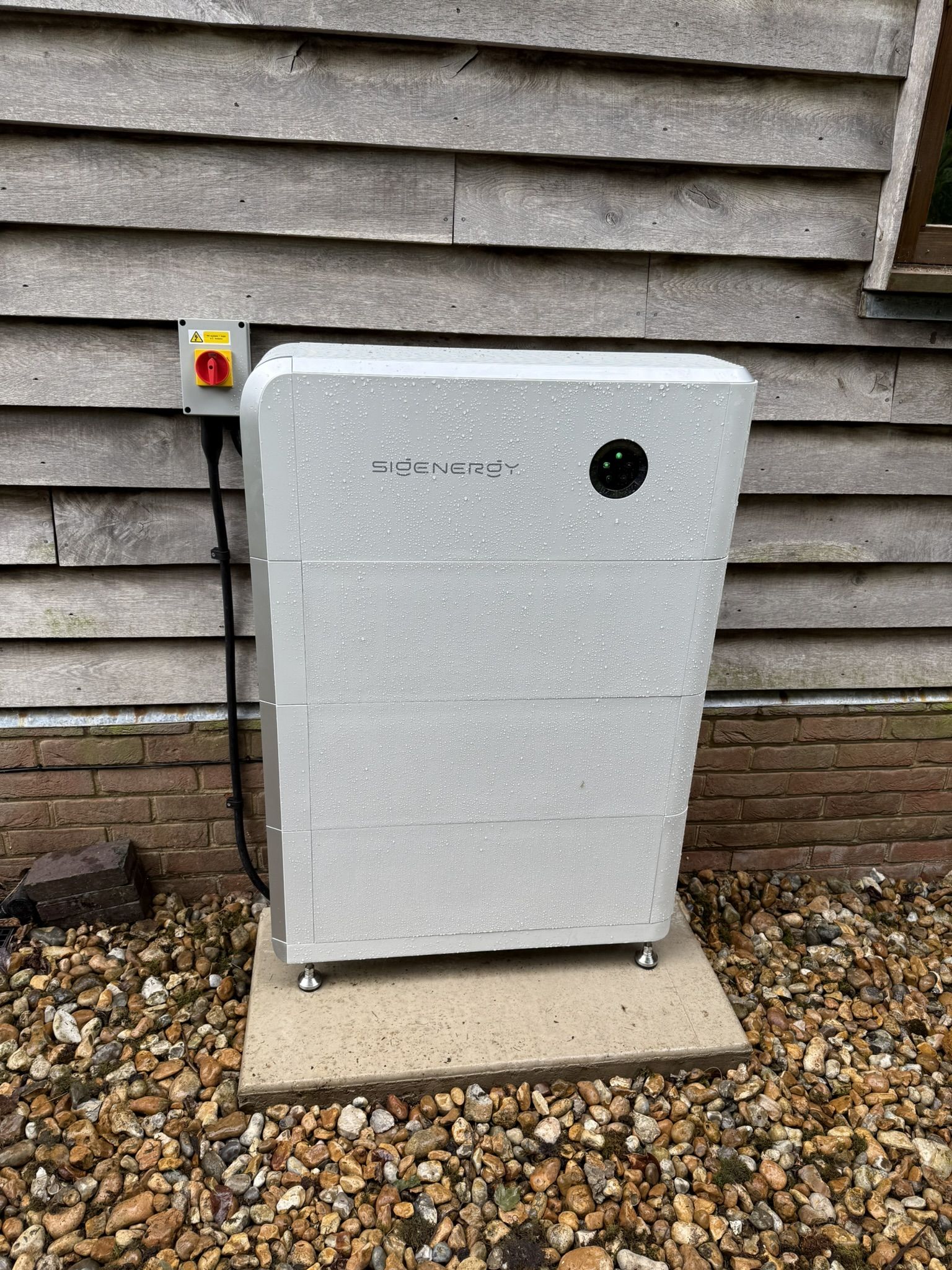
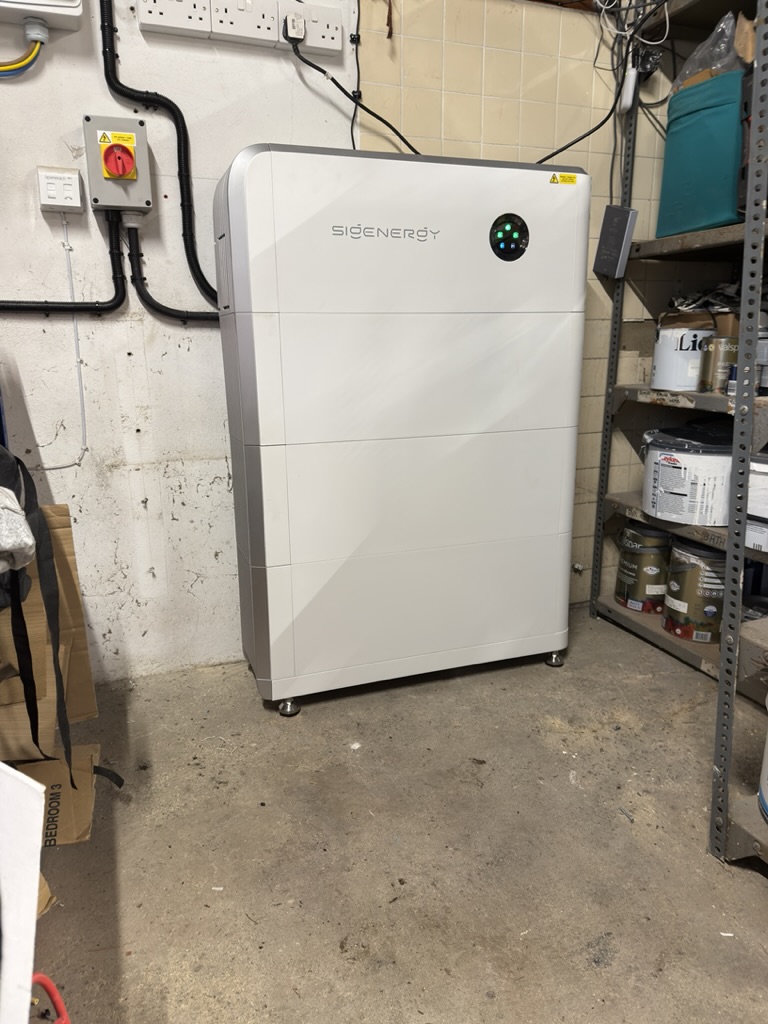
Store solar energy and charge overnight on cheap rates. GoodWe, Fox ESS, SigEnergy from £3,600. 0% VAT applied.
EV Charger Installation
Charge your EV from free solar. Zappi smart chargers, Ohme scheduling, SigEnergy 25kW DC. OZEV approved from £700.
Battery Storage & EV Charging in Hayling Island
Maximise your solar investment with battery storage and charge your EV from free solar.
Battery Storage Hayling Island
Store free solar energy and charge it overnight on an off-peak tariff.
EV Chargers Hayling Island
Charge your EV from free solar or on a cheap overnight tariff. Zappi, Ohme & SigEnergy 25kW DC. OZEV approved.
How a Hayling Island Installation Runs
Survey
We check roof pitch and direction, shading, the roof covering, how exposed the roof is to the wind, and the cable route to your consumer unit, and look at a year of your electricity use if you have it.
Design and fixed quote
You get a written design and a fixed price, with the fixing layout matched to the exposure of your roof and the battery sited above any flood-prone floor.
Network paperwork
SSEN is the distribution network operator here. Systems up to 16 amps per phase (3.68 kW on a single-phase supply) are notified under G98 after commissioning; anything larger — including many battery add-ons — needs a G99 application approved before installation.
Installation and testing
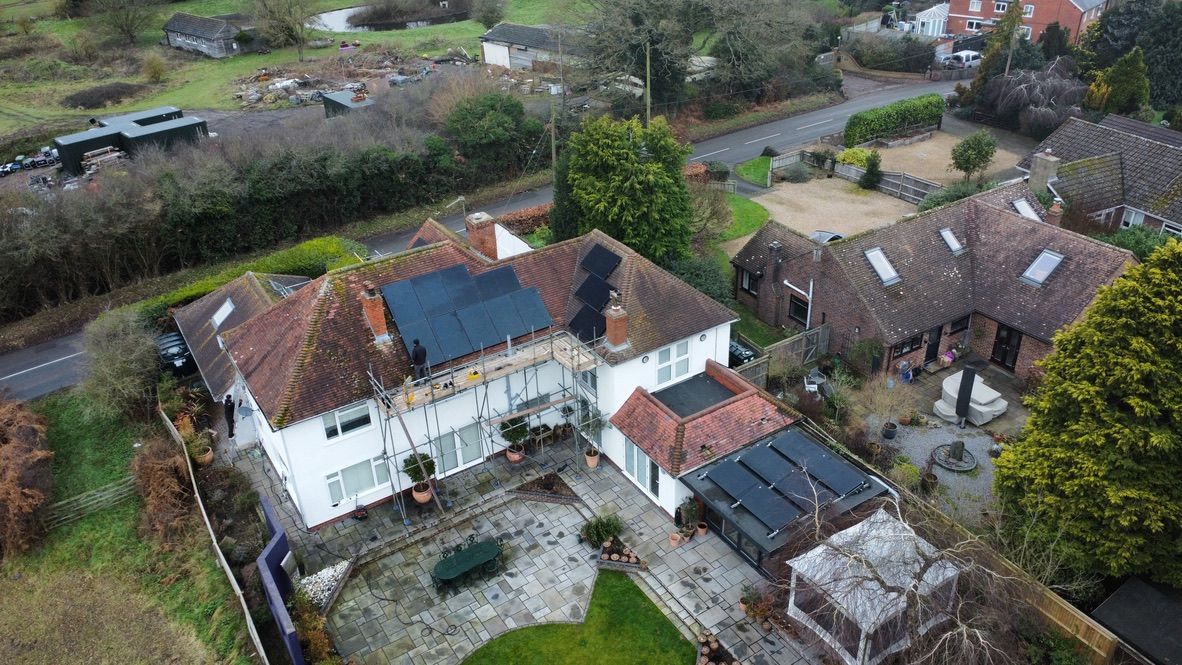
Scaffolding goes up first. The array, inverter and any battery are then fitted, the circuits are tested, and the system is commissioned before the scaffold comes down.
Handover
You receive the MCS certificate — needed to claim Smart Export Guarantee payments — with the commissioning records and warranty documents.
Solar Panel FAQs for Hayling Island
Answers use sourced figures: PVGIS for output by roof direction, DESNZ for costs, Ofgem and Octopus for rates.
PVGIS models a 4 kW array at a 35° pitch on Hayling at 4,526 kWh a year facing south, 4,269 kWh facing south-west, 4,219 kWh facing south-east, 3,555 kWh facing west and 3,491 kWh facing east. Output peaks in June, when a south-facing array models at 562 kWh, and bottoms out in December at 151 kWh.
Often, yes. East- and west-facing arrays model at about 77–79% of a south-facing one over a year, and most of that loss falls in winter: in June a west-facing array models at 532 kWh against 562 kWh facing south. West-facing panels also generate later in the day, when many households use more.
The panels themselves are sealed and glass-fronted; the parts to watch are the fixings and electrics. Choose panels tested to IEC 61701 for salt-mist corrosion, use aluminium rails with stainless fixings rather than mixed metals, and make sure exposed connectors and cable runs are rated for outdoor use.
Only for scheduling. The A3023 over Langstone Bridge is the one road on and off the island, so scaffold and deliveries come that way, and a bridge closure — as in Storm Eunice in 2022 — moves an installation date rather than stopping the job.
Usually not. Havant Borough Council is the planning authority, and roof-mounted panels on a house are permitted development within the 0.2 m projection and roof-height limits, including in conservation areas. Listed buildings need consent, flat-roof arrays in a conservation area need prior approval, and park homes or leasehold properties may have restrictions in the site licence or lease.
At October–December 2026 rates — 26.32p for electricity you use and 12p for electricity you export — a south-facing 4 kW array producing 4,526 kWh is worth about £738 a year at 30% self-use and about £932 at 60%. Against the South East average cost of about £7,436 for 4 kW, that is a simple payback of roughly 8 to 10 years.
Standard Octopus Flux, yes: Octopus paused new sign-ups in March 2026, but Flux was taking new customers again when we checked on 16 September 2026. Intelligent Octopus Flux only works with batteries on Octopus’s compatibility list, so check yours before you plan around it.
Brands We Install in Hayling Island
Three industry-leading brands to suit every budget and requirement
SigEnergy
Premium 5-in-1 system with integrated EV charger
Fox ESS
Hybrid inverters and stackable home batteries
GoodWe
Hybrid inverters and batteries, including three-phase options
Not sure which brand? Compare them:
Solar Guides for Hayling Island Homeowners
Solar, Battery & EV Services Near Hayling Island
All services available across Hampshire — one local company for solar panels, battery storage, and EV chargers.

Get Solar in Hayling Island
Free survey and quote for homeowners in Hayling Island and surrounding areas. We'll design the ideal system for your property.
Solar Panels near Hayling Island
We also install solar panels in these nearby areas:
Looking beyond Hayling Island? Costs, panel brands, roof types and the SSEN paperwork vary across the county. Our county guide covers what solar actually costs in Hampshire in 2026 and which brands hold up on south-coast roofs. See solar panels in Hampshire.