Key Benefits
EV Charging Market in 2026
The UK government has confirmed the 2035 ban on new petrol and diesel car sales. With over 1 million EVs on UK roads and charging costs at just 3-7p/mile with solar (vs 15-20p/mile for petrol), home EV charging is the fastest-growing home energy investment. OZEV-approved installers like Solent Solar ensure your installation meets all government standards.
Everything You Need to Know
1 EV Charger Costs and Options
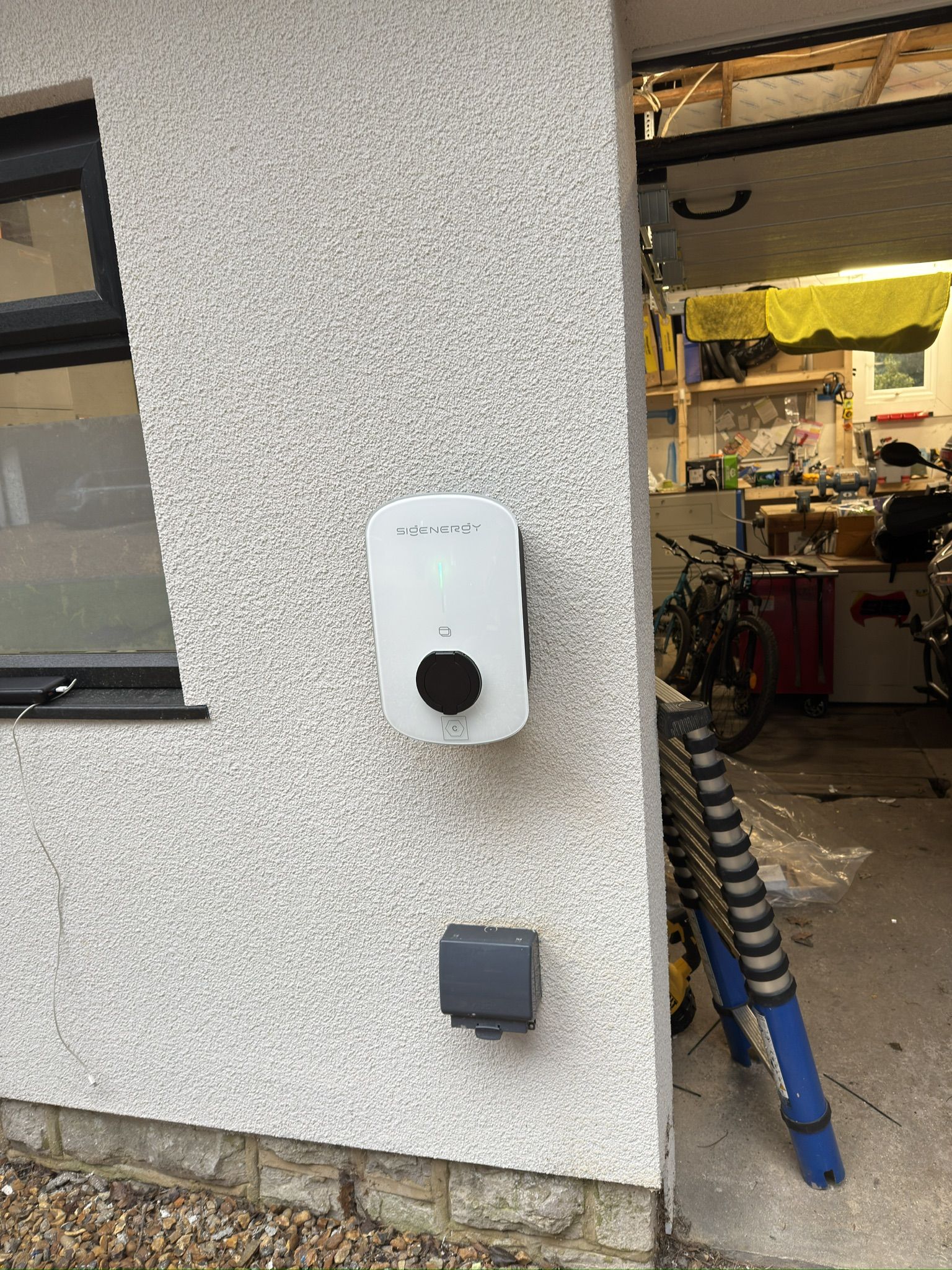
A standard 7kW smart charger costs £850-1,300 installed. Solar-integrated chargers like the Fox ESS L Series are £800-1,200. The premium SigEnergy 25kW DC bi-directional charger starts from £3,500 but offers V2H (Vehicle-to-Home) capability — your car becomes a massive battery that can power your home. The OZEV grant covers 75% of the cost, up to £500, for renters and flat owners (landlords can claim up to £500 per socket).
2 Solar-Powered EV Charging
Charging your EV with solar panels costs 3-7p per mile, compared to 15-20p per mile for petrol. A 4kW solar system generates enough energy for approximately 30 miles of driving per day — more than the UK average daily commute. When paired with a battery, excess solar energy stored during the day charges your car overnight. The Fox ESS L Series charger automatically prioritises solar energy, only drawing from the grid when your panels can't keep up.
3 Vehicle-to-Home (V2H) Technology
V2H is the next frontier in home energy. The SigEnergy DC charger can send up to 25kW of power from your EV battery back into your home during peak electricity hours. A typical EV has a 60-80kWh battery — far larger than any home battery system — meaning your car could power your entire home for 2-3 days. Compatible vehicles include Nissan Leaf (2022+), Kia EV6/EV9, and Ford F-150 Lightning, with more manufacturers adding support each year.
4 Choosing the Right Charger
For most homeowners, a 7.4kW smart charger provides an overnight full charge and is the most cost-effective option. If you have solar panels, the Fox ESS L Series adds intelligent solar integration. For those wanting the ultimate system, the SigEnergy 25kW DC charger offers faster charging (1 hour vs 8 hours) plus V2H capability. We assess your electrical supply, parking setup, and solar system during a free site survey to recommend the right charger for your situation.
EV Chargers Costs
Typical prices including installation. 0% VAT on all domestic systems.
Prices are indicative and vary by property. Get a precise quote with a free site survey.
How It Works
Our simple 5-step process from survey to switch-on
Site Assessment
We check your electrical supply, parking situation, and solar system compatibility to recommend the right charger.
Charger Selection
Choose from standard 7kW smart chargers, the Fox ESS L Series with solar integration, or the premium SigEnergy 25kW DC bi-directional charger.
Installation
Our OZEV-approved installers fit your charger in 3-4 hours, handling all electrical work, testing, and registration.
Solar Integration
We configure your charger to prioritise free solar energy, with intelligent fallback to grid power when needed.
Handover
Full demonstration of your charger, app setup, and guidance on optimising charging schedules for maximum savings.
Why Choose Solent Solar for EV Chargers
Hampshire has over 40 solar installers. Here's why our customers choose us.
Solar-Integrated Charging
Unlike standalone charger installers, we design EV charging as part of your whole energy system — solar, battery, and charger working together for maximum savings.
V2H Capability
The SigEnergy DC charger sends power from your EV back to your home. Your car becomes a massive battery, powering your house during peak hours.
OZEV Approved
As OZEV-approved installers, eligible properties can claim the government grant covering 75% of costs (capped at £350). We handle the paperwork.
Future-Proofed
Every charger we install is smart-enabled, solar-ready, and designed to work with the energy systems of tomorrow, not just today.
Recommended Brands for EV Chargers
Three price points to suit every budget and requirement
Frequently Asked Questions
A standard 7kW smart charger costs £850-1,300 installed. Solar-integrated chargers like the Fox ESS L Series are £800-1,200. The premium SigEnergy 25kW DC bi-directional charger starts from £3,500.
Yes. When paired with a solar system and smart charger, you can charge your EV using free electricity from your roof. A 4kW solar system can provide enough energy for around 30 miles of driving per day.
V2H technology lets your electric car act as a home battery, sending stored energy back to power your house. The SigEnergy DC charger is one of the few systems that supports this bi-directional charging.
The OZEV grant covers 75% of installation costs, up to £500, for renters and flat owners (landlords can claim up to £500 per socket). Standard homeowner-occupiers are not currently eligible, but solar-powered charging still offers significant savings.
EV Chargers Available Across Hampshire
Based in Whiteley — 54 locations covered across Hampshire and the South Coast
Our Other Services
Complete home energy solutions from a single trusted installer
Related Resources
Helpful guides and comparisons to inform your decision

Ready for EV Chargers?
Get a free, no-obligation survey and quote. We'll design the perfect system for your home.
Zappi v3 vs Ohme ePod vs Sigen AC Charger: Which Should You Choose?
There is no single "best" home charger — there is the best charger for your house, your car and your tariff. These are the three units we quote most often across Hampshire, and each one earns its place for a different reason. Tom and his small team fit all three, so the recommendation you get at survey is based on what suits your setup, not what happens to be in the van.
| myenergi Zappi v3 | Ohme ePod | Sigen EV AC Charger | |
|---|---|---|---|
| Max power | 7.4kW single-phase / 22kW three-phase | 7.4kW single-phase | 7kW single-phase (22kW three-phase variant) |
| Solar integration | Built-in surplus diversion — ECO mode blends solar with grid; ECO+ charges from 100% excess generation only. Works with any solar system, any inverter brand | Solar Boost via CT clamp — blends surplus solar with grid power; strongest at tariff automation rather than pure solar-only charging | 100% Solar, Solar Boost and Fast modes; natively orchestrated with the SigenStor battery system so panels, battery and car are managed as one |
| Tethered / untethered | Both available (tethered includes 6.5m Type 2 cable with holster) | Untethered only — you use your own cable | Tethered (5m Type 2) or socketed versions |
| App | myenergi app — solar monitoring, charge scheduling, boost control | Ohme app — the best smart-tariff integration on the market, including automated Intelligent Octopus Go scheduling; built-in 4G, no Wi-Fi needed | mySigen app — one app for solar, battery and EV together |
| Indicative installed price (7kW) | ~£1,000–£1,300 | From ~£949–£1,100 | ~£1,000–£1,300 (best value fitted alongside a SigenStor system) |
Our honest steer:
- Choose the Zappi if you have solar panels — or plan to add them — and want genuine surplus-only charging. ECO+ mode is still the benchmark for putting every spare watt of your own generation into the car, whatever brand your inverter is.
- Choose the Ohme ePod if you don't have solar yet and your priority is the cheapest possible overnight charging. Its tariff automation is the best we've used, and it's usually the lowest-cost quality unit on the wall.
- Choose the Sigen AC Charger if you have — or are quoting for — a SigenStor battery system. Running charger, battery and panels through one brain and one app is genuinely useful, not a gimmick.
Prices above assume a standard installation: a surface-run cable up to around 10 metres and a spare way in your consumer unit. Longer runs, groundworks or a fuse-board upgrade add cost, and we will tell you exactly what before any work starts — the price Tom confirms at survey is the price you pay.
OZEV Grants in 2026: Who Actually Qualifies
The government's EV chargepoint grants got more generous on 1 April 2026 — but the eligibility rules catch a lot of people out, so here is the position honestly stated.
EV Chargepoint Grant — flat owners, renters and landlords: up to £500
- From 1 April 2026 the grant covers 75% of the cost of buying and installing a chargepoint, capped at £500 per socket — up from the old £350 cap.
- Who qualifies: people who rent their home, or own a flat, with their own private off-street parking. Flat owners need freeholder or managing-agent approval; renters need written landlord consent.
- Landlords can claim for up to 200 sockets a year across residential properties under the separate landlord chargepoint grant.
- The catch most websites bury: if you own and live in a house, you do not qualify. The homeowner version of this grant closed back in 2022 and has not returned. If a salesperson promises you grant money on an owner-occupied house, walk away.
- Process matters: since April 2026, applications go through the government's Find a Grant service, and your eligibility must be confirmed before installation — install first and you lose the money. Funding is currently confirmed until 31 March 2027.
Workplace Charging Scheme — businesses: up to £500 per socket, 40 sockets
- Businesses, charities and public-sector bodies can claim 75% of purchase and installation costs (including VAT), up to £500 per socket, across a maximum of 40 sockets.
- The scheme has been extended to 31 March 2027, and the government has described this as its final year — if workplace charging is on your list, this is the window to do it.
Solent Solar is an OZEV-approved installer, which is a requirement for both schemes — a charger fitted by a non-approved installer gets no grant. Tom handles the paperwork side with you as part of the job, so the application is confirmed before a cable is run. Get in touch and we will tell you straight whether you qualify before you spend anything.
Charging From Your Solar Panels: What It Really Saves
The south coast is one of the best places in Britain to pair an EV with solar. A well-oriented array in Hampshire typically yields around 950–1,050 kWh per kWp per year — so a fairly ordinary 4kWp system generates roughly 3,800–4,200 kWh annually, and on a bright day much of that arrives in the middle of the day while your car sits on the drive doing nothing.
A solar-integrated charger uses a CT clamp to watch what your panels are exporting and diverts that surplus into the car instead of selling it to the grid. The economics are worth being honest about: every surplus kWh that goes into your car instead of the grid costs you only the export payment you would have earned — and Smart Export Guarantee rates vary widely, from around 4p per kWh on basic SEG tariffs to 12–15p on the better fixed export deals. On a low export rate, solar charging is the cheapest motoring you will ever do; if you're on one of the higher fixed export tariffs, a cheap overnight EV tariff can work out just as cheap per mile, and it's worth running the numbers both ways — which Tom will do for your tariff at survey.
Cost per mile, compared
| How you charge | Typical cost per kWh (mid-2026) | Approx. cost per mile* |
|---|---|---|
| Your own solar surplus | The export payment you forgo — typically 4–15p depending on your SEG tariff | ~1–4p |
| Overnight smart EV tariff (e.g. ~7p/kWh windows) | ~7p | ~2p |
| Standard-rate electricity (price-cap level) | ~26p | ~7p |
| Public rapid charging | Commonly 70–90p | ~20p+ |
*Assumes a typical EV efficiency of 3.5–4 miles per kWh. Tariff, export and public-charging prices move — treat these as mid-2026 indicative figures, not quotes.
Stacking solar with a smart tariff
The best-run homes we install for use both ends of the day: solar surplus fills the car (and the home battery) through the day, and a smart EV tariff tops up overnight at around a quarter of the standard rate. With a battery in the mix you can even charge the battery itself in the cheap overnight window and run the house on it through peak hours — the charger, battery and panels working as one system is exactly what our solar and battery packages are designed around.
A dose of realism, because we would rather you hear it from us: winter surplus in the UK is modest, and between November and February most of your charging will come from the overnight tariff rather than the roof. Solar-first charging is a summer superpower and a winter helper — anyone telling you your panels will run your car year-round is overselling. If you want the numbers worked through for your own roof and mileage, our EV charging and solar guide covers it in depth, or Tom will model it at survey.
Your questions, answered
What happens on installation day?
Do you need to notify the DNO before installing my charger?
Do I need three-phase power for an EV charger?
Tethered or untethered — which is better?
Related services & guides
EV charger installers near you
If you've searched 'EV charger installers near me' from anywhere in Hampshire — Gosport, Southampton, Chandler's Ford, Fareham or beyond — we're the OZEV-approved installer next door: based in Whiteley, installing Zappi, Ohme and solar-integrated chargers across the 30-mile Solent radius.
areas we cover · EV chargers Gosport · EV chargers Southampton
Covering the whole county. We install right across the county from our base in Whiteley. See EV charger installers in Hampshire for county-wide costs, brands and installation detail.