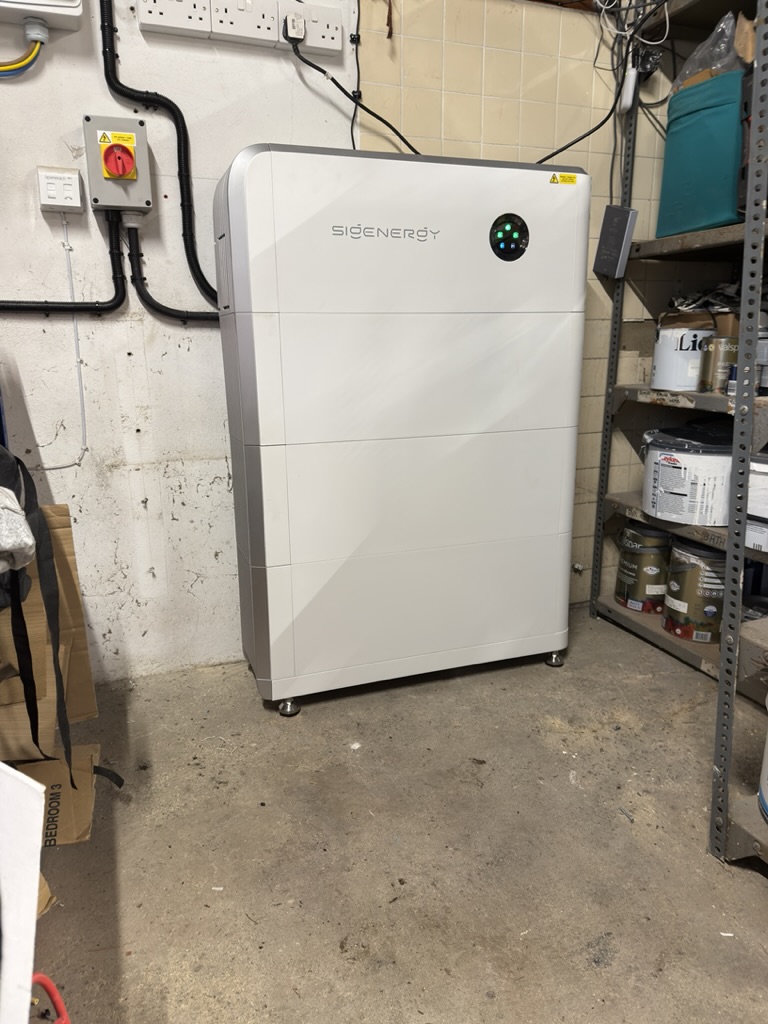
Can I Add a Battery to My Existing Solar System?
Yes — in almost all cases, you can add battery storage to an existing solar installation. The main factors that affect compatibility are the age and type of your inverter, the available space for the battery unit, and your property's electrical setup.
Solar systems installed since 2015 almost always use inverters that are compatible with modern battery retrofit options. Older systems (pre-2015) sometimes use legacy string inverters from brands that no longer sell retrofit-compatible batteries, but even these can be upgraded using AC coupling — a method that works independently of your existing inverter.
At Solent Solar in Fareham, we retrofit batteries to Hampshire solar systems installed by dozens of different companies — including many that have since ceased trading. We survey the existing system, confirm compatibility, and recommend the right battery for your inverter model and usage.
- Most UK solar systems installed since 2015: compatible with retrofit batteries
- Pre-2015 string inverters: usually compatible via AC coupling
- Key questions: who made your inverter? What is the model? How old is it?
- We service all brands — not just systems we installed ourselves
- Free site survey to confirm compatibility before you commit to any purchase
AC Coupling vs DC Coupling: Which Do You Need?
The two main methods of connecting a battery to an existing solar system are AC coupling and DC coupling. Understanding the difference helps you have an informed conversation with your installer.
DC coupling requires a hybrid inverter — a single unit that manages both solar generation and battery storage. It is the most efficient setup (96-98% efficiency) and is standard on all new solar+battery installations. However, for retrofit purposes, switching from a standard string inverter to a hybrid inverter means replacing the inverter, which adds £600-1,500 to the cost.
AC coupling keeps your existing inverter in place and adds an AC-coupled battery system with its own dedicated battery inverter. Efficiency is slightly lower (93-96%) because the electricity undergoes an extra conversion step, but the cost is often lower overall because you avoid inverter replacement. AC coupling is generally the better choice for FiT customers (see below) and for systems using inverter brands like SolarEdge, Fronius, or SMA that work well with AC-coupled batteries.
- DC coupling: most efficient (96-98%), requires hybrid inverter replacement
- AC coupling: slightly less efficient (93-96%), keeps existing inverter in place
- AC coupling: lower total cost if your existing inverter is in good condition
- FiT customers: AC coupling recommended to preserve generation meter readings
- SolarEdge/Fronius/SMA inverters: best paired with AC-coupled batteries (GoodWe Lynx or Sigenergy)
If you are on the Feed-in Tariff, we strongly recommend AC coupling for your retrofit. DC coupling with a new hybrid inverter changes how the generation meter reads, which can affect your FiT deeming payments. AC coupling keeps your generation meter untouched.
Will Adding a Battery Affect My Feed-in Tariff Payments?
This is the most common question from Hampshire homeowners who installed solar between 2010 and 2019 under the Feed-in Tariff (FiT) scheme. The short answer is: not if done correctly.
The FiT scheme pays you for two things: generation (every unit your panels generate, whether you use it or not, measured by the generation meter) and export (either measured by an export meter or 'deemed' at 50% of generation). A battery does not reduce what your panels generate — it only affects when and how you use that electricity.
With AC coupling, your existing generation meter is completely unaffected. Your panels still generate the same amount; you just store more of it rather than exporting it. Your generation payments continue unchanged. Your export earnings will decrease slightly (you export less to the grid) but your bill savings increase significantly, making the switch financially beneficial overall.
With DC coupling (replacing your inverter), the situation is more complex and you must notify your FiT licensee before making changes. We handle all FiT notifications as part of every retrofit installation.
- AC-coupled battery: generation meter unaffected, FiT generation payments continue
- Export earnings: decrease slightly as you use more of your own generation
- Overall net gain: significant (saving 27p/kWh instead of earning 5p/kWh export)
- DC coupling: must notify FiT licensee (we handle this for you)
- FiT scheme ends October 2033: maximising self-consumption now makes sense
Compatible Batteries for Retrofit Installations
Not all batteries work equally well as retrofits. Here are the most compatible options for the inverter brands commonly found in Hampshire FiT-era solar systems:
GoodWe Lynx Home U: the most universally compatible retrofit battery in the UK market. Works with SolarEdge, Fronius, SMA, Enphase, Solax, and most other inverter brands via AC coupling. Available from 5kWh to 30kWh. 0% VAT. From £2,800 installed.
Fox ESS ECS: connects most naturally to Fox ESS inverters. If you have a Fox ESS or Phono Solar hybrid inverter, this is the natural choice. Also works via AC coupling with other brands. From £3,800 installed.
SigEnergy SigenStor: works best with SigEnergy inverters or as a complete new system. For retrofit purposes, SigEnergy is best suited to cases where you are also replacing an end-of-life inverter — allowing you to upgrade to the full 5-in-1 system while solving the inverter replacement at the same time. From £5,500 installed for a new hybrid inverter + battery setup.
Solax X3-Hybrid: a popular mid-range option if you are replacing a non-compatible string inverter. The new hybrid inverter plus 9.5kWh Solax battery costs £4,800-6,200 installed.
- GoodWe Lynx Home U: best universal retrofit, works with all major inverter brands
- Fox ESS ECS: best if you have an existing Fox ESS inverter
- SigEnergy: best if also replacing an ageing inverter (full system upgrade)
- Solax X3-Hybrid: solid mid-range option for full inverter replacement retrofits
- Always confirm inverter brand and model before purchasing — we check this at survey
PAS 63100:2024 Fire Safety Rules for Battery Retrofits
From January 2025, all UK battery storage installations — including retrofits — must comply with PAS 63100:2024, the British Standard for the safe installation of battery energy storage systems. This matters for retrofits because some homeowners request battery installation in locations that are now prohibited.
Prohibited locations under PAS 63100:2024: loft spaces (prohibited — too difficult to evacuate in a fire), bedrooms (prohibited), living rooms and open-plan kitchen-diners used as habitable space (prohibited).
Permitted locations: garage (preferred — best ventilation, external wall available, easiest access for emergency services), utility room on external wall (permitted with adequate ventilation), purpose-built outdoor enclosure (requires IP65+ rated battery — GoodWe Lynx Home U at IP65 suits this).
Any installer offering to put a battery in your loft in 2025-2026 is either unaware of the regulation or ignoring it. Both situations should lead you to use a different installer.
- Loft: PROHIBITED under PAS 63100:2024
- Bedrooms and habitable rooms: PROHIBITED
- Garage: preferred location — compliant and practical
- Utility room: permitted if on external wall with ventilation
- Outdoor enclosure: permitted — requires IP65 battery (GoodWe Lynx advantage)
If another installer has quoted a battery in your loft or a bedroom, this is non-compliant with PAS 63100:2024. A non-compliant installation may void your home insurance and could create serious fire risk. Contact us for a second opinion.
How Much Does Retrofitting a Battery Cost?
Battery retrofit costs in Hampshire in 2026 (all at 0% VAT, all prices include installation, commissioning, MCS certification, and DNO notification):
AC-coupled battery retrofit (no inverter change): £2,800-5,500 depending on brand and capacity. This is the most common and cost-effective route.
DC-coupled retrofit (new hybrid inverter + battery): £4,800-8,500 depending on inverter brand, battery capacity, and whether the new inverter replaces a failed unit (in which case it may need full electrical work redoing).
The additional savings from a retrofit battery: approximately £350-600 per year for a 10kWh battery paired with a 4kW solar system, using the battery for daily solar storage. At electricity prices of 27.69p/kWh, the payback on a GoodWe 10kWh retrofit (£3,800-4,200 installed) is typically 7-10 years — with the battery lasting 15-20+ years.
For households on Octopus Agile or Intelligent Flux, who also use the battery for overnight cheap tariff storage and peak-rate discharge, total annual battery-related savings can reach £600-900/year, reducing payback to 5-7 years.
- AC-coupled retrofit (5kWh): from £2,800 installed
- AC-coupled retrofit (10kWh): £3,600-4,800 installed
- DC-coupled (new hybrid inverter + 10kWh battery): £4,800-6,500 installed
- Annual battery saving (10kWh): £350-600/year
- With Octopus Agile: payback as low as 5-7 years
If your existing solar inverter is over 10 years old, it may be approaching end of life. Replacing an ageing inverter with a new hybrid inverter at the same time as your battery retrofit is often more cost-effective than AC-coupling to a system that will need inverter replacement in 2-3 years anyway. We assess inverter age and condition at every free survey.
Related Guides
Continue reading with these related articles

Ready to Get Started?
Book a free, no-obligation home survey and get a personalised quote for your property.