
What a flat roof install involves
On a Flat Roof, the Frame Is the Whole Job
A pitched roof gives you the angle for nothing. On a flat roof you have to build it, and that frame — not the panel — is what the job lives or dies on. Panels sit on tilted supports held down by weight rather than bolted through the thing that keeps water out of your house.
That is what a ballasted system is: A-frames or east-west tubs weighted with concrete blocks or pavers, every foot sitting on a protection mat. Nothing penetrates the membrane, so the roof covering’s own warranty survives the installation. On a domestic roof this is almost always the right answer.
The kit we use: Van der Valk
On our own flat-roof jobs we use the Van der Valk system, made by Dutch mounting specialists Van der Valk Solar Systems: a ballasted frame that holds the panels at a shallow tilt, facing south or east-west, weighted down rather than fixed through the roof covering. Two recent installs by Tom and the team:
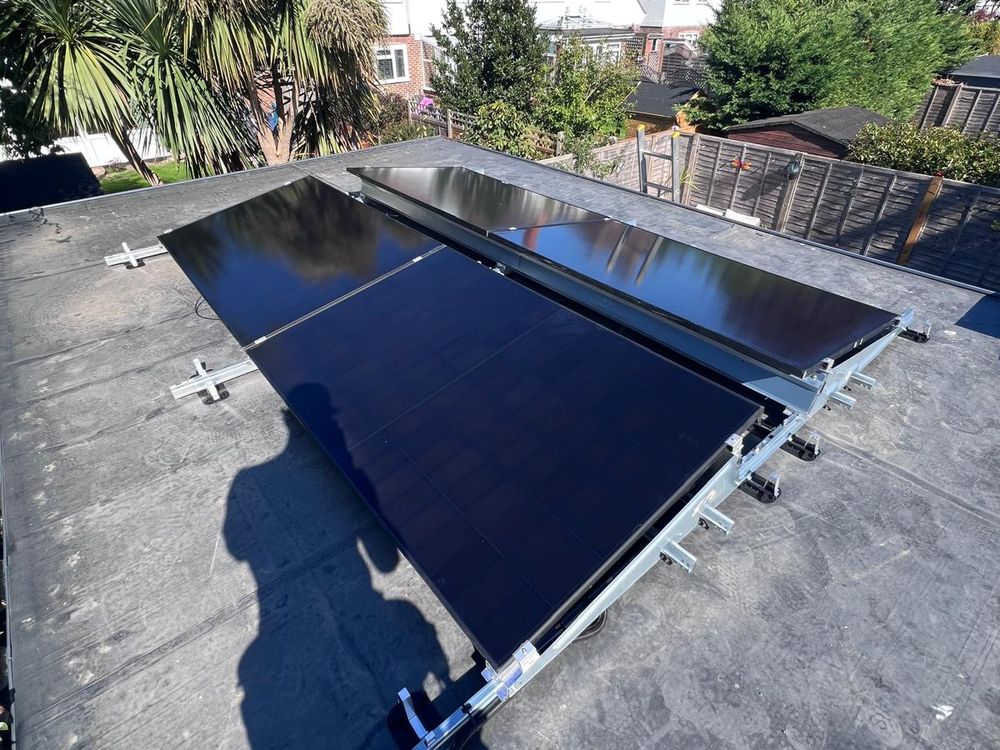
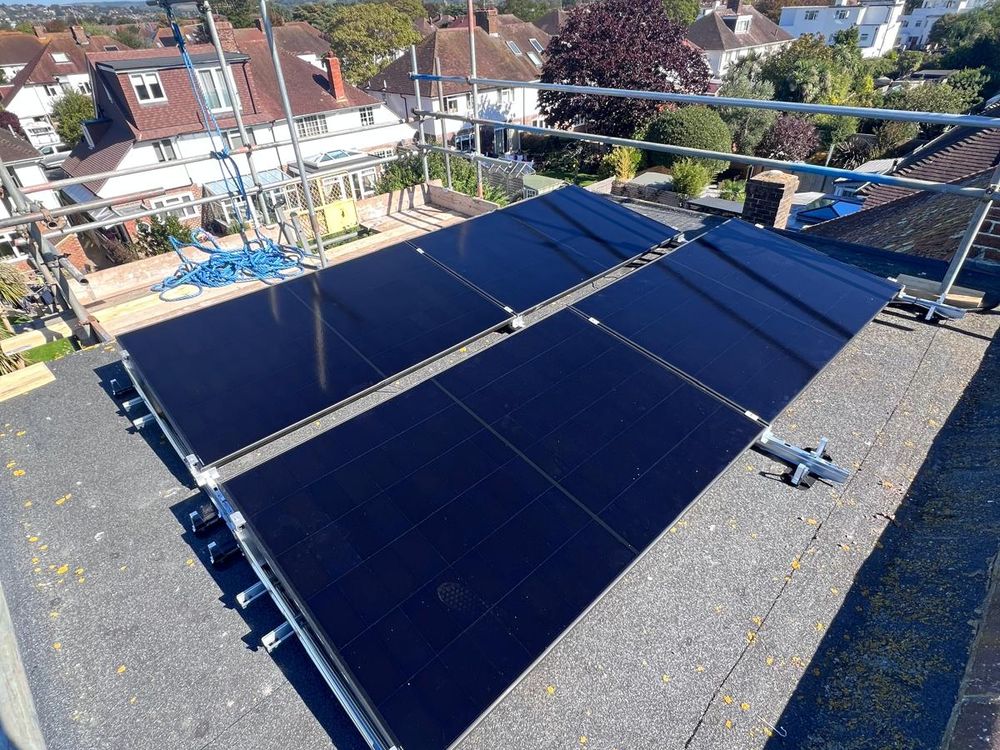
The alternative is mechanically fixing the frame down, which means a hole through the waterproof layer at every fixing, each one flashed and sealed properly. That is a fallback for a structure that cannot take the ballast, not a shortcut — and which one your roof needs is a question the survey answers.
The frame also sets the height, and height is what the wind gets hold of. The steeper the tilt, the harder the array is pulled at and the more ballast it needs to stay put. That is why most domestic flat-roof arrays sit at a shallow angle, and why the sensible conversation starts with the structure rather than with a panel count.
East–West or South? The Trade-Off That Sets Your Panel Count
South-facing rows on a flat roof have to be spaced far enough apart that the front row does not shade the one behind it when the midwinter sun is low. That spacing eats roof. A south layout therefore fits noticeably fewer panels on a given area than measuring the roof would suggest.
East-west tubs sit panels back-to-back in shallow pairs facing sunrise and sunset. They pack much tighter, so more kilowatts go onto the same roof, and generation spreads across the morning and the evening instead of spiking at noon — which usually means more of it gets used in the house rather than exported at 12p while you buy it back at 26.32p.
What the shallow angle costs over a year is measurable rather than guessable. PVGIS models a 4 kWp array on this stretch of coast at 4,526 kWh a year at 35° facing south, and 4,083 kWh at 10° — about a tenth less across twelve months.
The interesting part is when it goes missing. The same shallow array produces more than the steep one in high summer — 583 kWh against 562 kWh in the best month — and considerably less in midwinter, 90 kWh against 151 kWh. A flat-roof array is a summer-weighted array. That suits a household with daytime use or a battery, and suits a winter-heavy usage pattern rather less.
Ballast, Wind Uplift and Whether the Roof Can Take It
Two loads decide whether an array can go on a flat roof at all. The dead weight of panels, frames and ballast, which the structure underneath has to carry for the next couple of decades. And wind uplift, which is the force trying to take the whole thing off the roof in a February gale.
A tilted array on a flat roof behaves like a wing. The worst suction is not in the middle of the roof but around its perimeter, and worst of all at the corners — which is why a properly designed layout either loads those positions with more ballast or keeps the array out of them altogether.
It follows that an array is designed for one specific roof: its height, how exposed it is, what stands upwind of it, and where on the roof the panels sit. Anyone quoting a flat roof from a photograph and a panel count is guessing at precisely the part that matters.
Sometimes the structure simply will not take the ballast. Garage roofs, single-storey extensions and older timber decks are the usual cases. Then the honest answer is a smaller array, a different position, or not that roof — and we would far rather say so at the survey than after the scaffold is up.
Felt, EPDM, TPO and Asphalt: Protecting What Keeps the Water Out
The array sits directly on the layer keeping water out of your house, so the interface between the two is the detail worth caring about. Every foot gets a protection mat or slip sheet, and the material of that mat has to suit the membrane — some rubbers will attack some single-ply coverings over time.
Water also has to keep going where it went before. Feet should not sit in a hollow where water stands, and the array must not interrupt the falls that carry rain to the outlets. Blocking a flat roof’s drainage is a slow and expensive way to ruin it.
The roof has to stay serviceable too. A sensible layout leaves clear routes to outlets and upstands so a roofer can work later without dismantling your solar, and so leaves and silt can be cleared.
The first question we ask is how old the covering is. If the roof is near the end of its life, do the roof first and the solar afterwards — taking an array off and refitting it costs a great deal more than waiting a season. This is the most common reason we tell people to hold off.
Permitted Development and Flat Roofs
Solar on a house is usually permitted development under Part 14 of the General Permitted Development Order, but it comes with conditions, and the projection conditions are the ones a flat roof runs into. The Order limits equipment to 0.2 metres beyond the plane of a pitched roof slope, 0.2 metres beyond a wall abutting a highway, and 0.4 metres beyond other walls.
Read that wording closely and you will notice the roof limit is written for a pitched slope. A tilted frame standing proud of a flat roof is exactly the case the wording does not obviously cover, which is why councils do not all treat it the same way. We check with your planning department before designing the array rather than after fitting it: it costs an email and removes the only real risk on the job.
One condition applies whatever the shape of your roof — the equipment must be sited so as to minimise its effect on the external appearance of the building. On a flat roof that is usually easy, because a shallow array set back from the parapet is often invisible from the street.
In a conservation area or on a listed building the rules tighten: equipment may not go on a wall fronting a highway, and a listed building needs consent in its own right. An Article 4 direction can remove permitted development rights altogether, so check your council’s list — our conservation area solar guide covers what that means locally.
A Shallow Tilt Means More Cleaning
Rain cleans a steep array for you. It does that much less well at 10 degrees, because water runs off slowly and carries less with it when it goes. Flat-roof arrays hold dust, pollen and bird mess for longer, and a band of soiling along the low edge of a panel clips the current for every panel in that string.
The compensation is that a flat roof is the easiest kind to work on. There is no scaffold and no working at pitch, so cleaning and inspection are quick and cheap next to the same job three storeys up a tiled roof.
We cover flat-roof arrays under the same solar panel maintenance plan as everything else — and we would rather read the monitoring and clean only what needs it than sell you an annual wash you do not need.
Flat Roof Solar: The Numbers That Decide It
Everything below is either statute or modelled data, and every line says where it comes from.
Yields: EU JRC PVGIS 5.3 (PVGIS-SARAH3), 4 kWp, 14% system loss, modelled at Hayling Island. Planning: Town and Country Planning (General Permitted Development) (England) Order 2015, Schedule 2 Part 14, legislation.gov.uk, read 25 September 2026 (the amendment in force 27 August 2026 added restrictions on plug-in solar). Price cap: Ofgem, 1 Oct–31 Dec 2026 (Direct Debit). Export: Octopus OUTGOING-VAR-24-10-26, region H, from 1 March 2026. VAT: HMRC VAT Notice 708/6. Grid: ENA Engineering Recommendation G98/G99 — SSEN is the network operator here. Your actual layout and tilt are set by the survey.
How a Flat Roof Solar Installation Runs
Survey and structural check
We measure the roof, look at the covering and its age, check what the deck and the structure below can carry, and note how exposed the roof is. Nothing is quoted before this.
Layout and ballast design
South or east-west, tilt angle, row spacing and where the ballast is concentrated — all set for your roof rather than lifted off a standard drawing.
A written, fixed quote
One price, itemised, with the frame system named. If the roof needs replacing first, or will not take an array at all, that is what the survey says instead.
Network paperwork
SSEN is the distribution network operator here. Systems up to 16 amps per phase (3.68 kW on a single-phase supply) are notified under G98 after commissioning; anything larger — including many battery add-ons — needs a G99 application approved before installation.
Installation and testing
Scaffolding goes up first. The array, inverter and any battery are then fitted, the circuits are tested, and the system is commissioned before the scaffold comes down.
Handover
You receive the MCS certificate — needed to claim Smart Export Guarantee payments — with the commissioning records and warranty documents.
Flat Roof Solar FAQs
The questions we are asked most about flat roofs, answered with figures you can check.
Yes, and it is often easier than a pitched roof. The panels sit on tilted frames held down by ballast rather than bolted through the waterproofing, so nothing penetrates the membrane. What decides it is whether the structure can carry the extra weight and resist wind uplift — which is what the survey establishes.
Usually not, but a flat roof is the case worth checking. Part 14 of the General Permitted Development Order limits equipment to 0.2 metres beyond the plane of a pitched roof slope, and a tilted frame on a flat roof commonly stands higher than that. Councils do not all read it the same way, so we confirm with your planning department before designing the array. Conservation areas, listed buildings and Article 4 directions change the answer again.
Not if they are ballasted. A ballasted array puts no holes in the covering, sits on protection mats and keeps the drainage falls clear. The two ways flat-roof solar does cause damage are mechanically fixing through the membrane badly, and fitting an array onto a covering that was already near the end of its life.
Fewer than the area suggests if you face them all south, because the rows have to be spaced so they do not shade each other in winter. East-west pairs pack much tighter and will usually get considerably more capacity onto the same roof. We work the layout both ways and show you the difference in output and panel count before you decide.
A little, over a year. PVGIS models a 4 kWp array on this coast at 4,526 kWh at 35 degrees facing south and 4,083 kWh at 10 degrees — roughly a tenth less. The shallow array is summer-weighted: it beats the steep one in the best month, 583 kWh against 562, and falls well behind it in midwinter, 90 kWh against 151.
South wins on output per panel. East-west usually wins on total output from a given roof, because you fit more panels, and it suits self-consumption better by spreading generation across morning and evening instead of concentrating it at midday. If you export a lot at 12p and buy back at 26.32p, that spread is worth real money.
Generally yes. Rain does less of the work at a shallow angle, so soiling sits longer, and a band of dirt along the low edge of a panel costs more output than a thin film across the whole array. The consolation is that a flat roof is quick and safe to work on, so the cleaning costs far less than the same job on a tiled pitch.
Get a free, no-pressure quote
Tell us where you are and what you are considering — you will get a straight answer and a fixed written quote after a survey.
Related services and guides
Solar panel installation · Solar panel maintenance and cleaning · Solar on a bungalow · Solar planning permission in Hampshire · Hampshire solar panel costs · Battery storage