What is the Smart Export Guarantee?
The Smart Export Guarantee (SEG) is the scheme that pays small-scale generators for the electricity they export to the grid. It covers solar PV up to 5 MW and a few other low-carbon technologies, and it began on 1 January 2020. It follows the Feed-in Tariff, which closed on 31 March 2019, but works very differently (Ofgem).
Licensed electricity suppliers with at least 150,000 domestic customers must offer at least one SEG tariff, and smaller suppliers can join voluntarily. Suppliers decide the rate, the type and the length of each tariff, but the rate must be above zero pence per kWh at all times (Ofgem, SEG: Guidance for Generators). That is why rates differ so much between suppliers, and why they change.
To see what a system generates and costs before you think about export, use our solar panel calculator and the solar panel cost in Hampshire guide.
Best SEG Tariffs in 2026: What Each Type Pays
There is no single official league table, so each row below says where its figure comes from and when it was checked. Rates change: confirm the supplier's own page before you switch.
| Tariff type | What it pays | The catch | Source |
|---|---|---|---|
| Outgoing Octopus (variable) | 12p per kWh for every unit exported | Needs a smart meter that sends half-hourly export data. Pairs only with certain import tariffs. Octopus can change the rate, and says it gives notice | Octopus, 17 November 2026 |
| Prime Outgoing Octopus (12-month fixed) | 16p per kWh from 4pm to 7pm, 9p per kWh the rest of the day | Aimed at homes with a battery that can export in the evening. No exit fees. Same meter and pairing rules | Octopus, 17 November 2026 |
| Agile Outgoing Octopus (12-month fixed formula) | Half-hourly prices matched to day-ahead wholesale rates, uncapped | Suits homes with storage who can sell when prices are highest. No exit fees | Octopus, 17 November 2026 |
| Best fixed rates from other suppliers | About 12p to 13p per kWh | Most need you to buy your electricity from the same supplier | Comparison sites, 4 to 8 Oct 2026 (indicative) |
| Standard rates from smaller suppliers | About 3p to 6p per kWh | The lowest rates in this table | Comparison sites, 4 to 8 Oct 2026 (indicative) |
Octopus rows: octopus.energy/smart/outgoing, read 17 November 2026. Other rows are indicative ranges, not offers.
Time-of-use export tariffs that pay more at the evening peak, such as Intelligent Octopus Flux, also need a compatible battery. Octopus said on 7 October 2026 that Intelligent Octopus Flux was limited to customers who bought solar panels and a battery from Octopus: our Intelligent Octopus Flux guide has the rates for Southern England and the batteries it lists. For the Octopus export tariffs in full, see Outgoing Octopus 2026.
Five questions to ask before you switch
- Is the rate open to anyone, or only to the supplier's own electricity customers?
- Is it a flat rate, or does it pay more at certain times of day, and can your system actually export then?
- Is it fixed for a term or variable, and what notice does the supplier give of a change?
- Which meter does it need, and does that meter send half-hourly export readings?
- What proof of your installation certificate will the supplier ask for?
What Is the Best SEG Tariff for Your Home?
Without a battery, you export whenever the panels produce more than the house is using, mostly in the middle of the day. A flat rate is the simplest fit, so look for the highest flat rate you are eligible for.
With a battery, you can hold the surplus and export in the evening, so a time-of-use tariff such as Prime Outgoing's 16p window from 4pm to 7pm can pay more than a flat 12p, but only on the units you actually export in that window. As an illustration: a battery exporting 3 kWh a day in the 4pm to 7pm window earns 3 × 16p = 48p a day on Prime Outgoing against 3 × 12p = 36p on a flat 12p, about 12p a day more, or roughly £44 over twelve months. Your battery size and habits decide the real figure.
The size of your system matters too. Systems up to 3.68 kW per phase are notified to the network operator (G98), and larger ones need its approval first (G99).
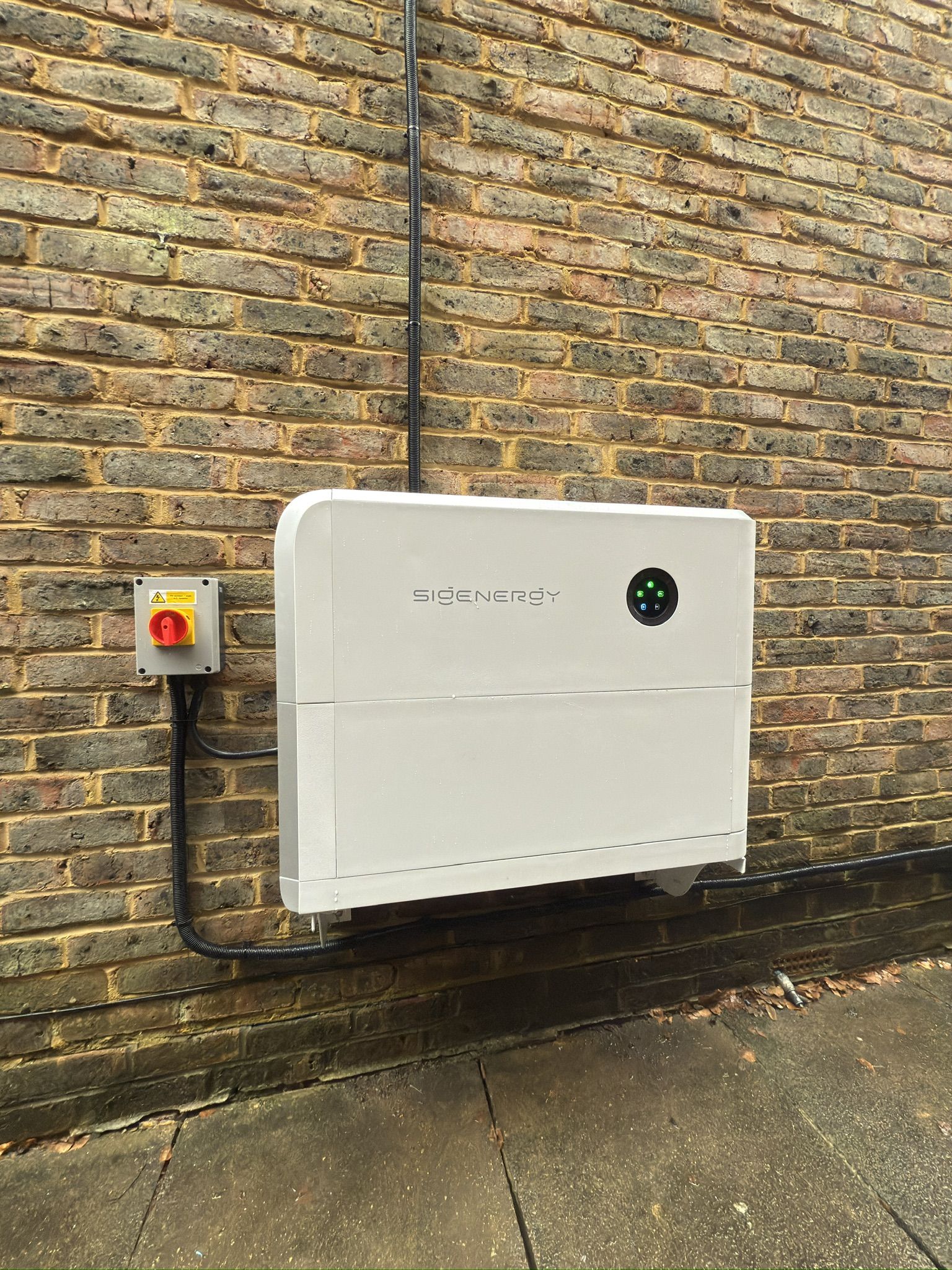
If you are choosing a battery with a tariff in mind, our GoodWe vs Fox ESS battery comparison sets out how two common brands differ, and the battery storage page covers what a fitted system involves.
What a Year of Export Is Worth
In Southampton, PVGIS (the European Commission's solar model) estimates about 1,064 kWh a year for every 1 kWp of panels facing south at 35 degrees, with 14% system losses assumed (PVGIS v5.3, 2005 to 2023 satellite data). A 4 kWp system therefore generates roughly 4,250 kWh a year. How much of that you export depends on when you are home, so the table shows what 1,000, 2,000 and 3,000 kWh of export earn a year at each rate.
| Export a year | 6p per kWh | 9p per kWh | 12p per kWh | 13p per kWh |
|---|---|---|---|---|
| 1,000 kWh | £60 | £90 | £120 | £130 |
| 2,000 kWh | £120 | £180 | £240 | £260 |
| 3,000 kWh | £180 | £270 | £360 | £390 |
Illustration: kWh exported × rate. 6p is the top of the smaller-suppliers range, 9p is Prime Outgoing outside 4pm to 7pm, 12p is Outgoing Octopus, 13p is the top of the best fixed range above.
Export or use it yourself?
Every unit you use yourself is a unit you do not buy. The Ofgem price cap for 1 October to 31 December 2026 is 26.32p per kWh for electricity (Great Britain average, direct debit), so a unit used at home saves about 26p while a unit exported at 12p earns 12p, less than half. That gap is the case for a battery, which moves daytime surplus into the evening. Whether it pays back depends on what it costs: our solar and battery cost page sets out published prices and a worked payback, and the solar panel calculator lets you test your own roof.
Who Qualifies for the SEG?
Ofgem's guidance sets out who can be paid under the SEG. In summary:
- A certified installation. An MCS certificate is the usual proof. Ofgem says other schemes may be equivalent, and without an MCS certificate the installation and installer should be accredited to EN 45011 or EN ISO/IEC 17065:2012.
- Solar PV up to 5 MW total installed capacity (hydro, onshore wind and anaerobic digestion up to 5 MW and micro-CHP up to 50 kW also qualify).
- An export meter. The export must be metered by a meter that can take half-hourly measurements and has an export MPAN. Octopus says almost all SMETS2 meters and most SMETS1 meters send the half-hourly export data it needs.
- Supplier rules on top. Octopus says Outgoing Octopus can only be paired with certain import tariffs, and that if you started receiving Feed-in Tariff payments in the last 12 months you cannot yet switch to it.
Always check the current terms on the supplier's own page, because they can change.
How to Join a SEG Tariff
- Find your installation certificate.
- Check your meter: it must record half-hourly export and have an export MPAN.
- Compare tariffs using the five questions above, and read the live rate on the supplier's own page.
- Apply to the supplier. Octopus's sign-up, for example, asks for a first meter reading and then connects to your smart meter to collect your export data.
- Check your first statement against what your system exported.
If you are still choosing a system, our guide to adding a battery to existing solar covers retrofits, and solar and battery storage covers a combined install.
SEG Questions Answered
What is the best SEG tariff?
There is no single best SEG tariff, because rates depend on the supplier, your meter and whether you have a battery. On Octopus's own page on 17 November 2026, Outgoing Octopus pays 12p per kWh and Prime Outgoing pays 16p per kWh from 4pm to 7pm and 9p per kWh the rest of the day. Comparison sites in early October 2026 put the best fixed rates open to anyone at about 12p to 13p, and smaller suppliers at about 3p to 6p. Check who can join before you switch.
What is Octopus's SEG rate?
Outgoing Octopus pays 12p per kWh and is a variable tariff. Prime Outgoing Octopus pays 16p per kWh from 4pm to 7pm and 9p per kWh the rest of the day, on a 12-month fixed term with no exit fees. Both need a smart meter that sends half-hourly export data (Octopus, 17 November 2026).
Which suppliers have to offer the Smart Export Guarantee?
Licensed electricity suppliers with at least 150,000 domestic customers must offer at least one SEG tariff. Smaller suppliers can take part voluntarily (Ofgem).
Is there a minimum SEG rate?
No figure is set. Suppliers choose the rate, the type and the length of their tariffs, but the rate must be above zero pence per kWh exported at all times (Ofgem).
Do I need an MCS certificate to get the SEG?
Your installation must be certified. An MCS certificate is the usual proof, and Ofgem says other schemes can be equivalent. Without an MCS certificate, the installation and installer should be accredited to EN 45011 or EN ISO/IEC 17065:2012 (Ofgem).
Do I need a smart meter for the SEG?
You need a meter that can take half-hourly measurements of your export and has an export MPAN (Ofgem). Octopus says almost all SMETS2 meters and most SMETS1 meters send the half-hourly export data its tariffs need.
Is it better to export solar power or use it myself?
Using it yourself is worth more. The Ofgem price cap for 1 October to 31 December 2026 is 26.32p per kWh (Great Britain average, direct debit), so a unit you use at home saves about 26p, while a unit exported at 12p earns 12p.
How much will I earn from the SEG?
Multiply the kWh you export by the rate. At 12p per kWh, 1,000 kWh of export earns £120 a year and 2,000 kWh earns £240. How much you export depends on when you are at home, and a battery reduces it by storing the surplus for the evening.
Related Guides
Continue reading with these related articles


Ready to Get Started?
Book a free, no-obligation home survey and get a personalised quote for your property.