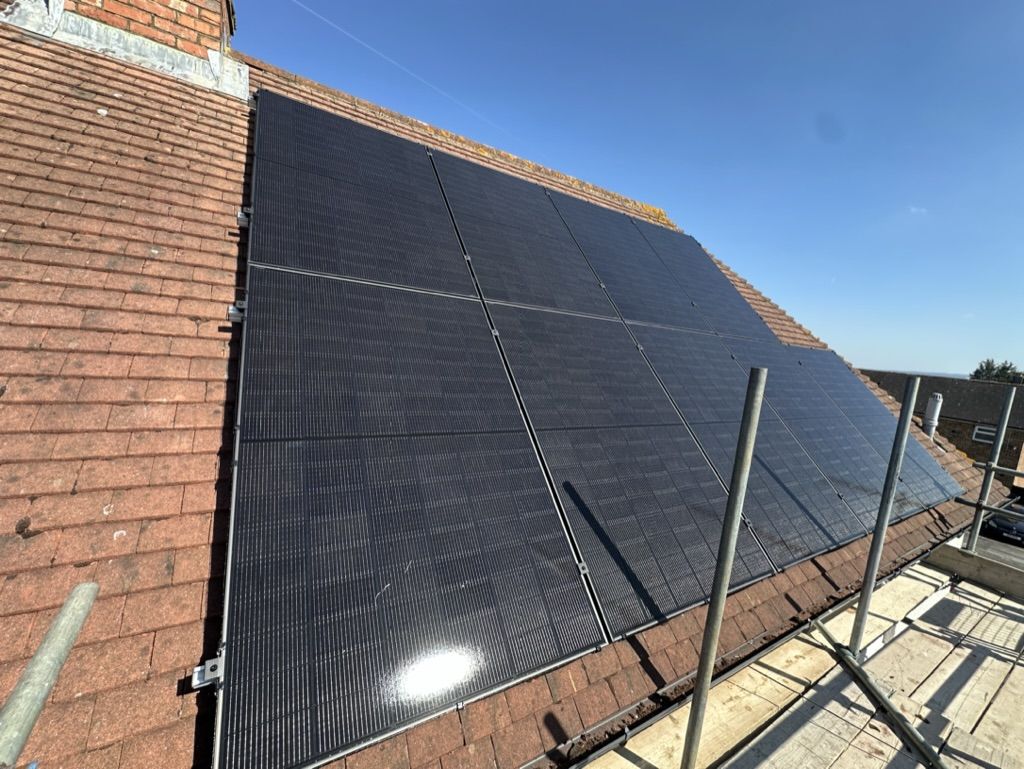
Why Add a Battery to Existing Solar?
A solar panel system without battery storage exports most of its generation to the grid during the day, when your home uses relatively little electricity. You receive 3-6p/kWh for this exported electricity through the Smart Export Guarantee, but pay 25-30p/kWh when you buy it back in the evening. A battery bridges this gap by storing daytime generation for evening use.
The impact is significant. Without a battery, a typical household self-consumes around 30-40% of solar generation. With a battery, this rises to 70-90%. For a 4kW system generating 3,600 kWh/year, this difference represents 1,440-2,160 additional kWh self-consumed annually. At current electricity prices, that is worth £360-540 per year in additional savings.
Adding a battery also enables you to use time-of-use tariffs like Octopus Agile, which charge as little as 5-10p/kWh at night. You can fill your battery from the cheap overnight grid supply and use it during the expensive 4-7pm peak period, compounding savings beyond what solar generation alone provides.
- Self-consumption increases from 30-40% to 70-90%
- Additional annual saving: £300-500 for a typical 4kW system
- Enables time-of-use tariff optimisation (Octopus Agile, etc.)
- Reduces reliance on expensive evening peak electricity
- Provides backup power during grid outages (some models)
- Qualifies for 0% VAT on retrofit installation
Battery retrofits qualify for 0% VAT when added to an existing solar system, the same as new-build installations. This saves approximately £600-1,100 on a typical retrofit battery, a significant reduction compared to the pre-2022 5% rate.
Compatible Battery Options
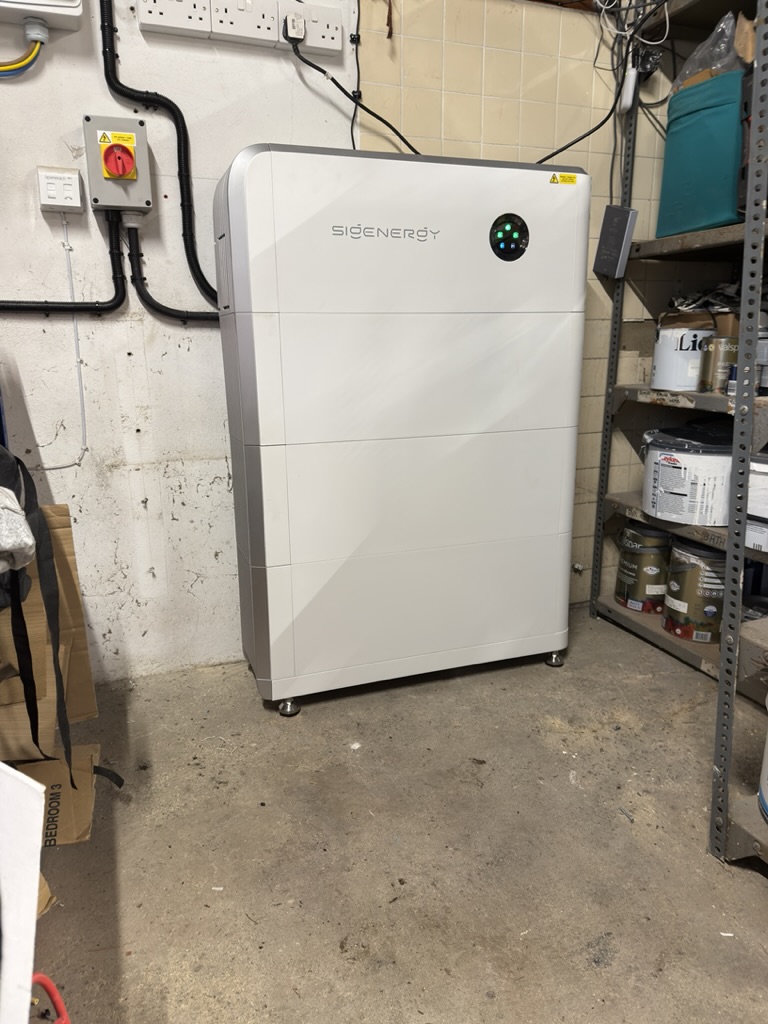
The three batteries we install for retrofit projects are the Fox ESS ECS series, GoodWe Lynx series, and SigEnergy SigES. Each works differently with existing solar systems.
The Fox ESS ECS batteries connect to your existing Fox ESS inverter via an AC-coupled connection, or can be integrated with third-party inverters. Available in 10.1kWh and 15.4kWh capacities. They use LiFePO4 chemistry, rated for 6,000 cycles over 10 years. The Fox ESS ECS is the most popular retrofit choice in Hampshire due to the high existing base of Fox ESS inverters.
The GoodWe Lynx battery is highly compatible with a wide range of third-party inverters, making it the best option if you have a SolarEdge, Fronius, SMA, or Enphase system installed by another company. Available in 5.1kWh modules that stack to 10.2kWh or 15.3kWh. The Lynx comes with GoodWe's PLUS+ warranty extension, giving 20 years total cover.
The SigEnergy SigES is designed for new SigEnergy 5-in-1 system installations and is less suitable for retrofitting into third-party systems. If you have a legacy inverter and want the SigEnergy system, we typically recommend replacing the inverter alongside adding the battery.
- Fox ESS ECS: 10.1kWh or 15.4kWh, ideal for existing Fox ESS inverters
- GoodWe Lynx: 5.1-15.3kWh, broadest third-party inverter compatibility
- SigEnergy SigES: best with SigEnergy inverter (may require inverter replacement)
- All batteries use LiFePO4 chemistry: safe, long-life, no thermal runaway risk
- All rated for 6,000+ cycles (10 years at one cycle/day)
Not all batteries are compatible with all inverters. Compatibility depends on your inverter brand, model, firmware version, and communication protocol (CAN bus, RS485, Modbus). We always verify compatibility before recommending a specific battery model.
Retrofit Battery Costs
The cost of adding battery storage to existing solar panels in Hampshire depends primarily on battery capacity and whether any inverter modifications or upgrades are required. For a straightforward retrofit to a compatible inverter, the installed cost ranges from £2,800-5,500 depending on battery size and brand.
A 5kWh battery is the minimum size worth installing for most households, costing approximately £2,800-3,500 installed. A 10kWh battery, the most popular choice, costs £3,800-4,800 installed. For households with EVs or high overnight consumption, a 15kWh battery costs £4,800-5,500 installed.
If your existing inverter is incompatible with any battery that meets your requirements, or if it is more than 7-8 years old and approaching the end of its reliable life, we may recommend replacing the inverter alongside adding the battery. Inverter replacement adds £800-1,500 to the cost but extends the system's operational life by 10-12 years and often adds monitoring capabilities that were not available on older inverters.
All retrofit battery installations qualify for 0% VAT, which reduces the gross cost by 20% and is already included in the prices above. The payback period for a retrofit battery, based on additional energy savings alone, is typically 6-9 years.
- 5kWh battery retrofit: £2,800-3,500 installed (0% VAT)
- 10kWh battery retrofit: £3,800-4,800 installed (0% VAT)
- 15kWh battery retrofit: £4,800-5,500 installed (0% VAT)
- Inverter replacement (if required): additional £800-1,500
- Additional annual saving: £300-500 (payback 6-9 years)
- Time-of-use tariff adds £200-400 more saving per year
The Retrofit Installation Process
Adding a battery to your existing solar system is a one-day job in most cases. The process is less disruptive than the original solar installation as no roof work is required — everything happens in your loft, utility room, or garage where the inverter is located.
The installation involves mounting the battery unit (typically on a wall near the existing inverter), installing a new consumer unit or adding to the existing one, connecting communication cables between the battery management system and the inverter, commissioning the system and calibrating the charging schedule, and testing all outputs and safety systems.
G98 or G99 DNO notification may be required, depending on the total capacity of your expanded system. We handle all notifications as part of the installation. An updated MCS certificate is issued after installation, which you will need to notify your home insurer and energy supplier.
The installation generates minimal disruption — typically a 4-6 hour job with a brief power outage of 30-60 minutes when the consumer unit connection is made. Most households do not need to take any time off work.
- Typical installation time: 4-6 hours
- No roof work required for AC-coupled battery retrofit
- Brief power outage: 30-60 minutes during consumer unit connection
- DNO notification handled by Solent Solar
- Updated MCS certificate issued
- No requirement to change energy supplier
Book a battery retrofit in autumn (September-November) when electricity demand and prices are rising but installation availability is typically better than spring and early summer. This maximises your first winter of savings from battery storage.
Maximising Battery Performance
A battery is only as valuable as the charging strategy behind it. Out of the box, most batteries default to a simple solar-only charging mode — they charge from solar generation and discharge when household demand exceeds solar output. This is fine, but time-of-use tariff optimisation can double the value of your battery.
Switching to a time-of-use tariff such as Octopus Agile or Octopus Go allows you to programme your battery to charge from the grid at cheap overnight rates (typically 5-10p/kWh) and use stored energy during the expensive 4-7pm peak (up to 50p/kWh in winter). In combination with solar charging during the day, this strategy can generate total annual savings of £1,200-1,800 for a household with a 10kWh battery.
All three batteries we install — Fox ESS ECS, GoodWe Lynx, and SigEnergy — support time-of-use tariff scheduling through their respective apps and can integrate with smart home energy management systems including Home Assistant and Loxone. We configure your preferred charging schedule during commissioning and provide guidance on how to adjust it seasonally.
- Default mode: solar charging only (simple but effective)
- Time-of-use mode: charges at cheap overnight rates (5-10p/kWh)
- Octopus Agile/Go: most popular tariff for battery optimisation
- Combined solar + TOU saving: £1,200-1,800/yr for 10kWh system
- Home Assistant integration available for advanced users
- We configure your charging schedule during installation
Before switching to a time-of-use tariff, check that your smart meter is compatible with the tariff you want. Octopus Energy requires a working smart meter in SMETS2 mode. We can check this during your survey and advise if an upgrade is needed.
Related Guides
Continue reading with these related articles


Ready to Get Started?
Book a free, no-obligation home survey and get a personalised quote for your property.