Government scheme explained
Warm Homes Loan Scheme: Solar Panels in Hampshire
A plain-English guide to the government’s Warm Homes Loan Scheme for solar panels: who can apply, the most the scheme allows and how to apply. It is a loan from a participating lender, not a grant, and you pay it back; the lender runs its own credit and affordability checks and decides. Solent Solar is the MCS-certified solar PV installer, not the lender.
- A loan, not a grant
- Homeowners and private landlords
- MCS-certified installer needed
- Apply to a lender, not to us
Get your MCS installation quote
Tom surveys your roof and sends an itemised solar PV quote with our MCS number on it, which is what a Warm Homes Loan lender asks for. We don’t arrange the loan and you are under no obligation.
At a glance
The Scheme in Four Points
The first participating lenders were named on 27 October 2026. Checked against GOV.UK and the scheme rules on 18 November 2026.
What it is
A loan from a participating lender, under a government scheme run by the Department for Energy Security and Net Zero, for home energy improvements. You pay it back on the lender’s terms. It is not a grant.
Who can apply
Homeowners anywhere in the UK, with or without a mortgage, and private landlords borrowing personally. The scheme sets no income test, but every lender runs its own credit and affordability checks.
What it covers
Named low-carbon improvements, such as roof-top solar panels, home batteries and heat pumps. Apart from a heat network connection, each must be fitted by an installer MCS certified for that improvement. Not insulation, and not roof repairs.
How you apply
To a participating lender, not to the government and not through us. GOV.UK lists the lenders taking part, and the lender decides whether to lend to you and on what terms.
Get your MCS installation quote
Our solar PV installations are MCS certified, and Tom covers Hampshire from our base in Whiteley, near Fareham. Get a written, itemised quote first, then decide how to pay for it.
Loan limits
How Much You Can Borrow
The government sets a maximum loan for each improvement. These are ceilings, not offers: each lender runs its own credit and affordability checks and decides whether to lend to you, how much, over what term and on what terms.
The improvement we are MCS certified to fit
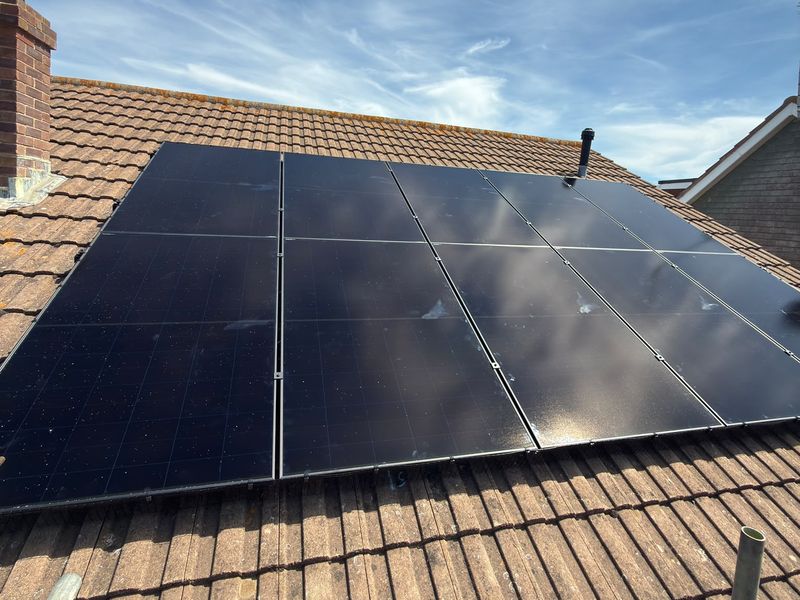
Solar panels on the roof, including adding panels to an existing system
A typical quote includes the scaffolding and the grid connection, and the limit counts the whole cost of the installation. The scheme covers new roof-top panels, so it won’t fund ground-mounted panels, roof repairs or other structural work needed first.
What we can’t fit under the scheme
Our MCS certificate covers solar PV only. The batteries and EV chargers we fit can’t go through the scheme with us, so a quote from us for a Warm Homes loan is for solar panels.Other improvements the scheme covers
| Improvement | Loan limit |
|---|---|
| Battery storageon its own or with solar panels, including a battery added to panels you already have | Up to £15,000 |
| Air source heat pumpair to water; the limit counts the cost before the Boiler Upgrade Scheme grant comes off, so with the £7,500 grant a lender can lend at most £12,500 | Up to £20,000 |
| Ground source heat pumpcounted before any Boiler Upgrade Scheme grant comes off | Up to £35,000 |
| Biomass boilerrural homes only, with a Boiler Upgrade Scheme grant; the limit counts the cost before the grant comes off, so with the £5,000 grant a lender can lend at most £15,000 | Up to £20,000 |
| Micro-renewablesdomestic wind turbines and micro hydro only | Up to £20,000 |
| Heat network connection | Up to £7,500 |
| Air-to-air heat pumpnot eligible yet: no MCS certification exists for it yet; the limit counts the cost before any Boiler Upgrade Scheme grant comes off | Up to £10,000 |
Our MCS certificate covers solar PV only, so we can’t fit any of these under the scheme.
Not covered
The scheme doesn’t fund insulation, even alongside another improvement, or replacement roofing and other structural work needed before panels go on. It doesn’t pay for gas, oil or LPG boilers, or for anything that isn’t on the scheme’s list.Source: the government’s Warm Homes Loan Scheme factsheet (27 October 2026) and the scheme rules (version 3, September 2026). You can apply for a loan for more than one improvement, and each keeps its own limit; the lender still runs its own credit and affordability checks and decides. Whichever way you pay, installing solar panels in a home carries 0% VAT until 31 March 2027 (HMRC VAT Notice 708/6).
Eligibility
Who Can Apply
You can apply if
- You own the home, with or without a mortgage, or you let it as a private landlord borrowing personally
- The property is in the UK
- It is a home, not a commercial building
- The loan pays for one or more of the improvements the scheme lists
- An MCS-certified installer does the work
- You pass the lender’s credit and affordability checks
Good to know
- Tenants and social housing can’t apply. If you rent privately, only your landlord could apply, borrowing personally.
- There is no income threshold, but every lender runs its own credit and affordability checks and can add rules of its own, such as asking for an Energy Performance Certificate.
- The scheme doesn’t require other energy efficiency upgrades first, and it has no restriction by property type.
- You can’t do the work yourself.
Five steps
How to Apply
You apply to a lender that offers Warm Homes loans, not to the government. GOV.UK sets out three routes: directly to a participating lender, through your mortgage provider, or through an installer or retailer that arranges finance for the work. We don’t arrange Warm Homes Loans, so with us you apply to the lender yourself.
- 1
Get your installation quote
Ask MCS-certified installers for a written quote, priced for your home after a survey. The scheme rules ask lenders to check that it shows the installer’s MCS number, the installation address, an itemised breakdown and the system size, and is dated within the last six months. Our solar quote checklist goes through each line.
- 2
Compare participating lenders
GOV.UK lists the lenders taking part. Compare the APR, the total amount you would repay and how long you would be paying, not just the monthly figure, and check that the lender will lend for work by the installer you choose.
- 3
Apply to the lender
Apply directly or through your mortgage provider. Some installers and retailers also arrange the finance; we don’t arrange Warm Homes Loans. GOV.UK says a loan funded through the scheme will say so in its product details. The lender runs its credit and affordability checks and decides.
- 4
The installation
An MCS-certified installer fits the system and registers it on the MCS Installation Database, which produces the MCS certificate lenders use to check the work. You can’t do the work yourself.
- 5
A possible audit
Your home may be picked for an audit by an auditor working for the Department for Energy Security and Net Zero, or by MCS. Being picked doesn’t mean anything is wrong. If an auditor working for the Department for Energy Security and Net Zero needs to visit, you will get at least 48 hours’ notice.
Don’t mix them up
Warm Homes Loan or Warm Homes: Local Grant?
Two schemes with similar names and very different rules. If your household is on a lower income, check the grant first.
| Question | Warm Homes Loan Scheme | Warm Homes: Local Grant |
|---|---|---|
| What it is | A loan you pay back, plus any interest the lender charges | A grant: improvements paid for, nothing to repay |
| Who it is for | UK homeowners and private landlords; no income test, but lenders run credit and affordability checks | Lower-income households in England, in homes rated D to G on their Energy Performance Certificate |
| Who runs it | Participating lenders, under a government scheme | Local councils |
| How to apply | To a participating lender | Through your council |
| What it pays for | Solar panels, batteries, heat pumps and more | Insulation and low-carbon heating, and sometimes solar panels |
In Portsmouth and a consortium of 30 other council areas, including parts of Hampshire, the Warm Homes: Local Grant runs through Warmer Homes, led by Portsmouth City Council. When we checked its site on 18 November 2026, it said the scheme was oversubscribed, with new applicants added to a waiting list while it awaits a decision from its funding provider, the Department for Energy Security and Net Zero, on further funding. Check with your own council whether it takes part and what it has open. GOV.UK explains the Warm Homes: Local Grant.
Where we fit in
An MCS-Certified Installer, Not a Lender
Solent Solar Limited is MCS certified for solar PV (MCS certificate NIC-40078294, through NICEIC), which is the installer requirement the scheme sets for solar panels.
We are not a Warm Homes Loan lender. We don’t arrange Warm Homes Loans, and we don’t pass your details to a Warm Homes Loan lender: you apply to the lender yourself. This page is general information about a government scheme, not financial advice.
What we do: Tom surveys your roof, looks at how you use electricity and checks your fuse board, then sends a written, itemised quote. We fit the system, handle the network operator paperwork and register the installation with MCS.
Questions, complaints and scams
If Something Goes Wrong
A problem with a lender
Raise it with the lender first. If it isn’t resolved, you may be able to take it to the Financial Ombudsman Service.
A problem with an installer
Raise it with the installer first. If you can’t resolve it, GOV.UK says to make a complaint to MCS, which certifies installers.
A question about the scheme
Ask the lender about its loans. For the scheme itself, GOV.UK gives the DESNZ Warm Homes Loan Scheme team: WHLS@energysecurity.gov.uk.
Suspect a scam
Report fraud, scams or misuse to Warm Homes Counter Fraud at WHLScounterfraud@energysecurity.gov.uk. Never feel pushed into signing on the spot.
FAQs
Frequently Asked Questions
Is the Warm Homes Loan a grant?
No. It is a loan from a participating lender, which you pay back on the lender’s terms. The council-run Warm Homes: Local Grant is a separate scheme for lower-income households in England.
Can Solent Solar arrange a Warm Homes loan for me?
No. We are not a Warm Homes Loan lender, we don’t arrange these loans and we don’t pass your details to a Warm Homes Loan lender: you apply to the lender yourself. We provide the written MCS installation quote the lender asks for.
What interest rate will I pay?
Each lender sets its own rates, terms and fees, and GOV.UK says to contact the lenders directly about them. We can’t quote or compare them for you.
Do I need an MCS-certified installer for a Warm Homes loan?
Yes. GOV.UK says an MCS-certified installer must do the work, and the scheme rules say the installer must be MCS certified for that specific improvement when it is fitted. Lenders check this. Our MCS certificate, NIC-40078294, covers solar PV.
Can a battery go on a Warm Homes loan with you?
Not with us. The scheme covers battery storage, on its own or with solar panels, up to £15,000, but the installer must be MCS certified for battery storage. Our MCS certificate covers solar PV only, so a battery we fit can’t go through the scheme.
Can an EV charger go on the loan?
The scheme rules allow a chargepoint only as part of a solar panel or battery installation, and only where the installer and the chargepoint are approved by the Office for Zero Emission Vehicles. The loan can’t cover a chargepoint that a grant has already helped pay for. We don’t include a chargepoint in a quote for a Warm Homes loan.
How do I know a loan is part of the scheme?
GOV.UK says the loan product will say if it is funded by the government through the Warm Homes Loan Scheme. Check the lender is on GOV.UK’s list of participating lenders before you share any details.
Does it cover homes across Hampshire?
Yes. The scheme covers homes anywhere in the UK, including Southampton, Portsmouth, Fareham, Winchester and the rest of Hampshire, and we survey and install from our base in Whiteley.
Sources: GOV.UK’s Warm Homes Loan Scheme guide, the government factsheet (27 October 2026), the scheme rules (version 3, September 2026) and HMRC VAT Notice 708/6, checked on 18 November 2026. The scheme is new, so details may change: always check GOV.UK and the lender’s own terms.